
Oops! Something went wrong while submitting the form.


By Katelyn Lopez
Katelyn is VP Customer Success of Comprehensive, a compensation platform for automating compensation reviews, communicating compensation with employees, managing pay ranges, and benchmarking.


Compensation benchmarking sounds straightforward until you try it.
Two compensation teams benchmark the same Senior Software Engineer role. One lands at $145,000. The other lands at $175,000. Both teams believe they’re using reputable salary benchmarking tools. Both can defend their numbers. And both are technically correct.
The gap is not the tool. It is the data underneath and the inconsistencies with which we evaluate the insights.
Every compensation benchmarking software provider relies on a different methodology. Some scrape job postings daily. Some rely on employee self-reports (and we know some of those are less reliable than others.) Some aggregate structured employer surveys. Others integrate directly with HRIS systems. Each of these approaches measures a different slice of the labor market, from a different population, at a different point in time.
That doesn’t make any one source wrong. It just means they’re answering slightly different questions. And the inconsistency can create blind spots in your benchmarking.
Enterprise-grade surveys, like Mercer and Radford, provide depth, validation, and board credibility. They also come with significant cost and update cycles that may not quite match your fast-moving hiring needs. Then there are free salary benchmarking tools that provide accessibility and speed, but often lack verification, peer filtering, or total rewards context.
Most companies default to one source or another without really asking a harder question. Does this data reflect companies like ours? Does it cover the right levels we need? Is it current enough to act on immediately? Can we defend it to Finance or the board?
Compensation decisions are only as strong as the data behind them. And the right data depends on company size, industry, geography, role mix, and how mature your compensation program is.
In this guide, we’ll walk through five distinct categories of compensation benchmarking data, explain how each is collected and verified, and outline where each fits. The best compensation strategy today blends multiple data types. No single source covers every role, level, geography, and comp element. Strong comp teams understand what each methodology does well, and they use software that allows them to combine the right sources for their business.
Once you know which data to trust, you’ll need the right platform to manage it. We’ll connect those dots at the end.

Before we review any category, we need a consistent framework. Otherwise, every salary benchmarking tool looks compelling in isolation. Here are eight criteria we use when evaluating compensation benchmarking software and salary benchmarking tools.
How often is the dataset updated? Daily. Quarterly. Annually. If you’re hiring aggressively in a competitive market, twelve-month-old data may not be sufficient.
Is the data HRIS-integrated, employer-submitted, employee self-reported, or scraped from public postings? Verification directly affects credibility and defensibility.
Can you filter by company size, funding stage, revenue, industry, and geography? Benchmarking a Series B SaaS company against a Fortune 500 enterprise rarely produces meaningful numbers.
Does the dataset include base salary only, or does it cover bonus, equity, long-term incentives, and benefits? For executive roles, base salary alone tells you very little.
Does the tool distinguish between IC and manager? Between L3 and L5? Or does it simply show “Software Engineer” as a single bucket?
Is the data US-only? Global? Strong in specific metro areas? Weak in emerging markets?
Is it free? Give-to-get? Subscription-based? A $30,000 survey contract is not feasible for every team.
Can you move directly from data to band-building and compensation review cycles, or are you exporting spreadsheets and manually reconciling numbers?
Keep this framework in mind as we walk through the five major data methodologies available today.
Want to start benchmarking right now? Search free salary data from 6,000+ US tech companies →
Real-time job posting data is one of the fastest-growing categories of salary benchmarking tools. It aggregates active job listings and extracts posted salary ranges.
Automated systems scrape job boards, company career pages, and ATS feeds daily or weekly. Salary ranges are parsed and normalized by role, level, and geography.
Pay transparency laws in states like Colorado, New York, California, and Washington have significantly improved the quality of this data. Employers are now required to disclose ranges in many regions, which has expanded visibility into current asking prices.
Real-time data reflects what companies are offering today, not what they paid last year. It’s accessible, often free, and increasingly accurate for tech and technical roles. For lean teams and early-stage companies, it provides a fast starting point without survey participation requirements.
Job postings reflect asking price, not actual accepted compensation. Ranges can be broad, often spanning multiple levels. Equity and bonus information are typically missing. Coverage is strongest in tech and weaker in niche or executive roles.
Comprehensive.io offers free, daily-refreshed tech salary data with no survey submission requirement. As companies scale, that same dataset can be layered with premium survey data inside the broader compensation management platform.
Employee-reported data has existed for years and remains widely used.
Individuals voluntarily submit compensation information. Platforms aggregate submissions into searchable salary ranges by title and company. Some verify employment, while others rely entirely on anonymous input.
These are free salary benchmarking tools that are easy to access. Levels.fyi is particularly useful for understanding big tech leveling and total compensation structures.
Verification is inconsistent. Some entries include equity, others do not. Reporting bias is common. Data may include submissions from several years ago with no clear date filtering. You cannot filter meaningfully by peer company size or stage.
When compensation decisions need to withstand scrutiny from Finance, executives, or a board, crowdsourced data alone rarely holds up. Comprehensive.io gives you that same, free and instant data, that also happens to be verified and refreshed daily from actual job postings. And you can graduate when you’re ready to our compensation management software with premium survey data.
Traditional salary surveys remain the gold standard for many established organizations.
Consultancies invite companies to submit detailed compensation data. The data is validated, matched against proprietary job libraries, and distributed as structured reports or portal access. These operate on paid or give-to-get models.
These surveys offer credibility with boards and compensation committees. They cover base salary, bonus, equity, and benefits. Global coverage is robust. Job leveling frameworks are rigorous and structured.
Cost is significant. Data may be twelve months old by the time it’s used. Survey submission processes are manual and can introduce errors. Enterprise companies dominate participation pools, which may skew benchmarks for smaller firms.
For companies that need survey credibility but want to avoid spreadsheet wrangling, Comprehensive.io integrates Mercer and Salary.com data directly into our compensation management software. That puts enterprise-grade benchmarks at your fingertips in a modern and very usable interface, integrated with your HRIS.
Aggregator platforms combine multiple underlying data sources, including surveys, government data, job postings, and employer submissions.
These providers license data from various inputs, normalize it, and present it through portals or APIs. They often integrate into HRIS systems or compensation planning tools.
Broad coverage across industries. Useful for non-tech roles. Government data provides authoritative direction for compliance purposes.
Limitations
Methodology can be opaque. Freshness varies by underlying source. Data pools often skew toward mid-market and enterprise organizations.
Comprehensive integrates Salary.com alongside Mercer, allowing teams to combine aggregator breadth with survey-grade depth inside a single platform integrated with your HRIS. Imagine not having to juggle all those vendor contracts to find what you need.
Executive compensation deserves its own category because everything changes at this level.
Most salary benchmarking tools top out at Director or Senior Director. That’s exactly where compensation stops being formulaic and starts being negotiated. At the executive level, base salary becomes one piece of a much larger structure. Equity often carries the majority of the value. Long-term incentives are tied to performance milestones. Packages are reviewed by boards, not just HR.
And the margin for error gets smaller.
Public company executive pay is disclosed in proxy filings. It’s structured and accessible. Private company executive pay isn’t. That’s the data startups actually need, and it’s the hardest to find.
Traditional surveys like Mercer and Radford do have executive data. It’s credible. It’s board-recognized. But it’s largely enterprise-skewed and refreshed on annual cycles. If you’re a Series B or Series C company competing for leadership talent, benchmarking against Fortune 500 compensation structures doesn’t give you clarity. It gives you distortion.
Startup-focused platforms like Pave and Carta pull from real-time HRIS and cap table data. That visibility is valuable, especially for equity grants. But those datasets aren’t built specifically for executive decision-making depth. Filtering by funding stage, capital raised, valuation, and revenue isn’t always precise enough. And for C-suite hires, precision matters.
This is where many venture-backed companies struggle. They’re competing for leaders against both other startups and large public companies. They need executive benchmarks that reflect companies operating at the same stage, with similar capital structures, not just the same job title.
AI leadership roles have amplified the gap.
Head of AI. VP of Machine Learning. Chief AI Officer. These aren’t fringe roles anymore. They’re core to product strategy. But most traditional surveys haven’t fully built structured categories for them yet.
Real-time job postings might show salary ranges. That tells you what companies are advertising. It doesn’t tell you how equity is structured, what performance-based incentives look like, or how board-level negotiations are landing.
When you’re hiring someone who will shape your technical roadmap, “good enough” data isn’t good enough.
Equity is usually the majority of total compensation. If your benchmarking source doesn’t include equity, you’re only seeing part of the picture.
Peer group selection matters more than industry labels. A Series B CEO should be benchmarked against other Series B companies with similar capital raised and revenue. Headcount alone doesn’t get you there.
Board credibility matters. Compensation committee members want recognized, defensible data sources. Most executive pay decisions rely on at least two or three data inputs to validate assumptions before approving a package.
And the financial impact is outsized. Overpaying erodes runway and dilutes equity faster than expected. Underpaying means losing a leadership hire to a competitor who benchmarked more accurately.
The Comprehensive Executive Compensation Survey was built specifically for venture-backed companies. It’s sourced from more than 500 VC-backed startups across 20+ top-tier firms, including Sequoia, Accel, General Catalyst, and Bessemer. The data covers C-suite, VP, board, and emerging AI leadership roles. You can filter by capital raised, revenue, headcount, valuation, and funding stage.
Access is free for companies who participate in the survey (only takes 15 minutes). Data is anonymized. There’s no $30,000 survey contract and you’re not working off a once-a-year snapshot.
For venture-backed companies making leadership hires, executive benchmarking isn’t just another line item in the comp process. It’s one of the most consequential financial decisions you’ll make.
At this level, methodology matters.
There is no universal “best” compensation benchmarking tool. The right mix looks different depending on your size and industry. Here’s how it typically plays out in practice.
No single methodology covers every role, level, geography, and comp element. The goal isn’t picking one tool. It’s combining the right data for your reality.
Now that you know which data to trust, the next step is managing it inside a system built for compensation review cycles, pay band architecture, and total rewards communication.
Read next: The Best Compensation Management Software for 2026 →
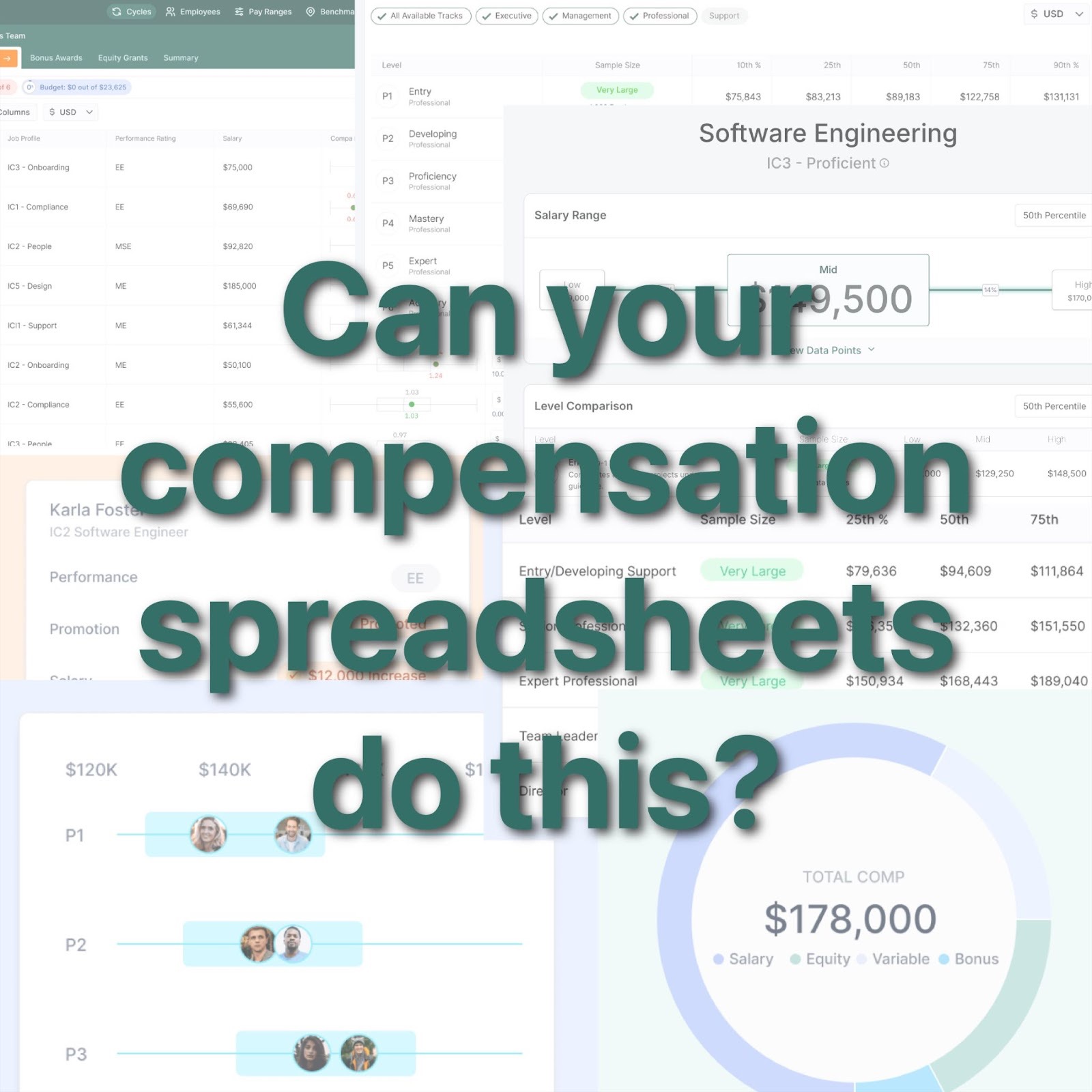
Most compensation benchmarking software is built around a single data philosophy.
Some platforms rely exclusively on HRIS-integrated, give-to-get datasets. Others operate as annual survey providers. A few focus only on job posting data. Each approach works within its lane, but modern compensation teams don’t operate in one lane.
The best teams start with what’s fast and accessible. Then they layer in deeper survey sources as governance increases. They supplement executive decisions with specialized data. They don’t rip and replace systems every time their comp program matures. Instead, the top teams evolve.
Comprehensive was built around that reality.
Instead of locking you into one methodology, we combine them:
This mirrors how sophisticated comp programs actually operate. Start with real-time visibility. Add survey-grade validation when governance requires it. Benchmark executive roles with proper peer filters. Move from data to action inside one system.
Compensation benchmarking tools are only valuable if they translate into defensible decisions. That requires credible data and controlled workflows. Not disconnected vendor contracts and exported spreadsheets. When you’re ready to streamline your comp process and benchmarking tools, Comprehensive.io can help.
Start with free data today. Scale to premium when you’re ready.
Search Free Salary Data →
Schedule a Demo →
Comprehensive.io offers free, daily-refreshed salary data from 6,000+ US tech companies with no survey submission required.
They use five primary methods which include job posting scraping, employee self-reporting, HRIS integration, structured employer surveys, and multi-source aggregation.
Fast-moving tech roles benefit from quarterly benchmarking. Most other roles align with annual compensation review cycles.
Mercer collects validated employer-submitted data through structured surveys. Glassdoor relies on anonymous self-reports with limited verification and date filtering.
Yes. Many free salary benchmarking tools provide real-time data. Platforms like Comprehensive allow teams to start free and scale to premium survey data as needed.
Executive benchmarking requires equity-inclusive data filtered by company stage and funding. The Comprehensive Executive Compensation Survey is purpose-built for VC-backed companies and includes VP, C-suite, board, and AI leadership roles.
Compensation benchmarking is less about finding the single best tool and more about understanding which data reflects your reality. The strongest compensation strategies blend multiple sources, apply disciplined evaluation criteria, and use software that connects data to execution.
Start with what is fast and accessible. Layer in depth as your program matures. And make sure the data behind your numbers is as defensible as the decisions you’re making.
